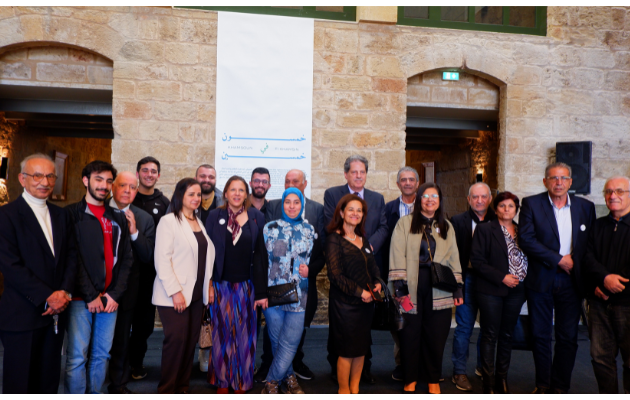
On the occasion of the 50th anniversary of the outbreak of the Lebanese Civil War, the Ministry of Culture invited civil society organizations and committees to participate in an event addressing the war and its memory, held under the title “Fifty in Fifty” at the National Library in Sanayeh. The Memory and Future Forum (@memoryfuturelb), together with its member organizations, including Fighters for Peace, took part in the event.
The significance of this invitation lies in the fact that it is the first time that official authorities have initiated gatherings centered on the Lebanese Civil War, marking a notable shift in how collective memory and historical narratives are being addressed.
In his address, Prime Minister Nawaf Salam stated that “no one won the war,” calling for the construction of a discourse that unites Lebanese citizens on the basis of citizenship and justice. The event was attended by Minister of Culture Ghassan Salamé, several ministers and MPs, representatives of diplomatic missions, and civil society organizations.
Fighters for Peace participated in a panel discussion titled “At the 50th Anniversary: Testimonies and Approaches to Dealing with the Past,” moderated by Dr. Martin Akkad. The association was represented by Ziad Saab and Assaad Chaftari, alongside Ms. Souad Harbawi from the Committee of Families of the Kidnapped and Missing in Lebanon, and Mr. Ali Abou Dehn from the Association of Detainees in Syrian Prisons.
Ziad Saab delivered a powerful personal testimony reflecting on his experience as a former combatant. He spoke about the factors that lead young people into war, drawing on his own past experience, highlighting the lack of education, limited access to schooling, inherited misconceptions, and the uncritical glorification of political ideologies. He explained that it was only when he recognized the contrast between Lebanon before and after the war, and fully grasped the consequences of violence, that a long journey of transformation began.
Assaad Chaftari, for his part, emphasized that the war did not begin on April 13, but much earlier—when exclusionary ideas were instilled in his mind that defined “the other” as an enemy. He explained that his exit from the cycle of violence began when he was able to accept the “other,” understand their experience and motivations, and gradually move toward empathy and reconciliation. This spiritual and human journey helped him break free from the prejudices that fueled the war. He also reflected on a pivotal moment in his life when he felt an inner inspiration, which he described as a “divine revelation,” leading him to write a public apology addressed to the Lebanese people in 2000 for his actions during the civil war. This letter marked the beginning of his path toward reconciliation and civil peacebuilding.
.png)